
Langround · Concept · 2024–25
The claim form that asks what happened first
A self-initiated concept with a fictional client. I worked out the claim logic on a FigJam board and designed the logo and twelve desktop templates, including the claim form.
It was never built, so this case study shows the design and the reasoning behind it rather than results.
- Role
- Sole designer — claim logic, logo and website
- Scope
- 12 desktop templates, the claim form and the logo
- Client
- Fictional — a self-initiated concept
- Status
- Concept · Not built
Flight CompensationPricingFAQBlogENLogin
Disrupted Flight?
Choose what was your disruption
 Delayed Flight
 Canceled or Rescheduled flight
 Denied Boarding
 Missed ConnectionClaim now!
01 · The project
The project
Langround is a fictional EU flight-compensation service, invented as the brief for this project. In the scenario, a small team in Sofia files claims under EU Regulation 261/2004 for passengers whose flight was delayed, cancelled, overbooked or missed a connection, and keeps 25% of the payout only when a claim succeeds.
The scenario gives the team the legal process and no product. Passengers who may be owed €250 to €600 rarely know which rules apply to them, and a form that opens on airports, flight numbers and booking references makes them do that work before learning whether there is a claim at all. The brief asked for the opposite order, on one page: settle eligibility first, with questions a passenger can answer from memory, and reveal each next step below the last.
02 · Design decisions
Design decisions
- 01
Four steps, marked on the rules
I ringed the eligibility tree into four steps: what happened, the flights, the passengers, then contact details, documents and a signature. A blue arrow moves the departure date and airline out of step one and into the flight details, so step one asks only about the disruption.
Small red numbers set the order inside step one: what happened, the question for that disruption, then the arrival delay.
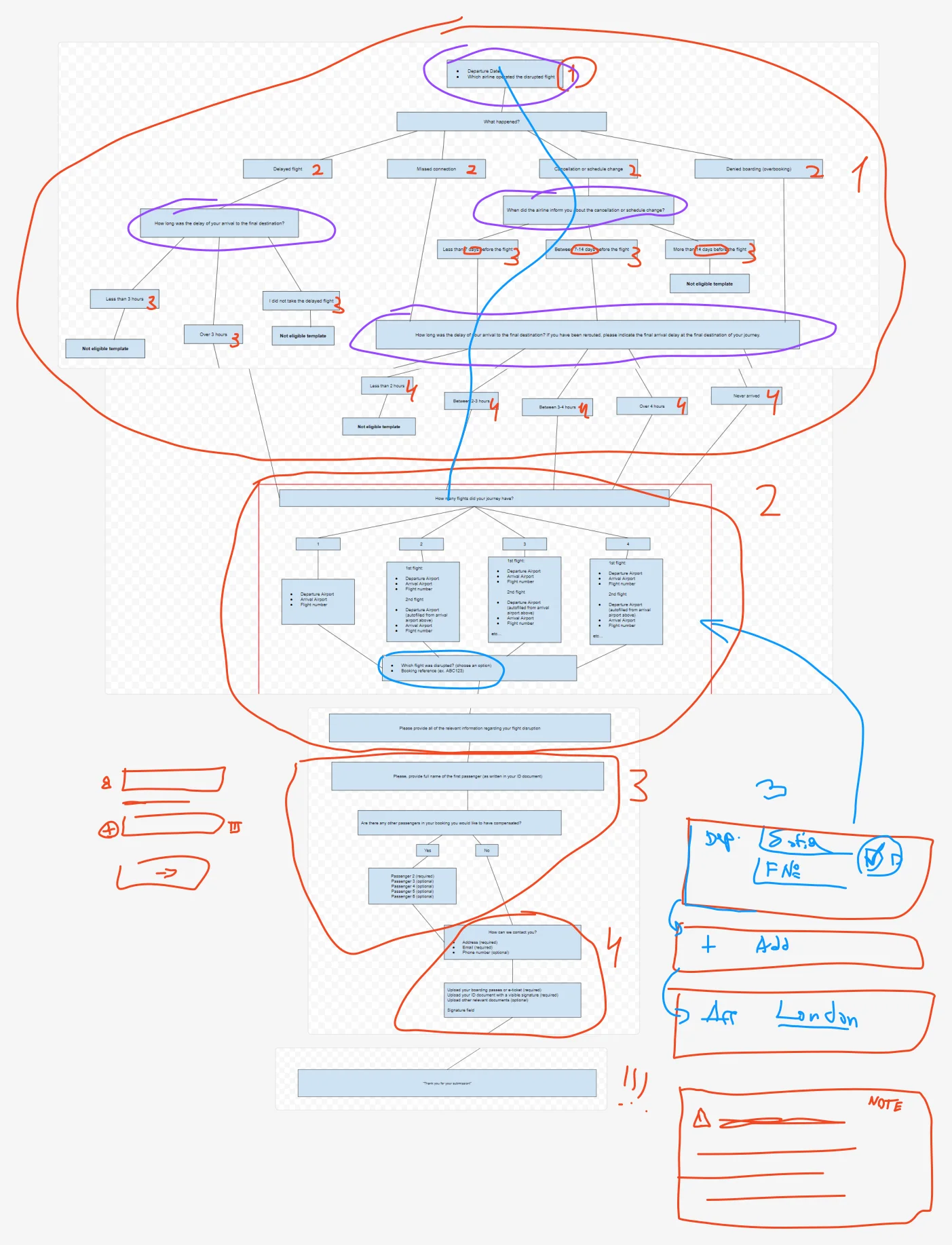
Design file · The FigJam board. Beside the tree, sketches of the flight card that step two became: departure, flight number, add a connection, arrival. - 02
Step one is answered with taps
Three questions, each answered with buttons: how the flight was disrupted, when the airline gave notice, and how late the passenger arrived. The notice question appears only for a cancellation. Airports, dates and flight numbers wait for step two.
The homepage opens on the same first question: the hero lists the four disruptions as buttons, with Claim now underneath.
- What Happened?
- Flight Details
- Passenger Information
- Document Submission
ContinueReconstructed from the design file, and working: it opens in the state the file draws. Choose another disruption and the notice question leaves; only a cancellation asks it. - 03
One chart for the whole claim
The rules behind the form, drawn as a flowchart with its own legend. A claim opens, the passenger names the disruption, delays and cancellations answer one more question, and every claim that continues is checked for arrival delay, then identity (KYC), then succeeds.
One branch on the board runs the wrong way round; What I would revisit explains it.
Workflow diagram, redrawn from the FigJam board in its own colours and shapes. Labels are tidied; every route is as the board draws it. - 04
The payout comes before the pitch
Straight after the hero, three amounts set by flight distance: €250 under 1,500 km, €400 up to 3,500 km and €600 beyond. The fee is on the same page: 25% of a successful claim, and nothing if the claim fails.
The amounts are fixed by the regulation, which makes them the one thing the site can promise before it knows anything about the flight.
How much can you get back?
Here's how much you can get back
- €250flights below 1500 km

- €4001500 to 3500 km flights
- €600flights over 3500 km

Reconstructed from the homepage’s second band. The distance captions are set in Magistral in the file; Roboto stands in for it here. - €250flights below 1500 km
- 05
Three lockups, one symbol
The file's Logo page holds three lockups around the same idea, a plane climbing out of a circle: the Poppins wordmark the screens use, a two-tone lockup on an app tile, and a Magistral wordmark drawn in four colourways in a frame named Logo ver 3.
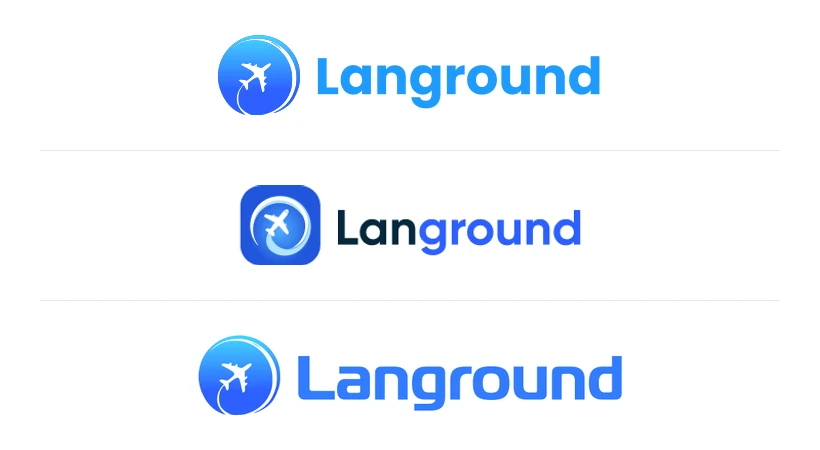
Design file · Top to bottom: the lockup on the screens, the app-tile lockup, Logo ver 3.
03 · What I delivered
What I delivered
Twelve desktop templates at 1920 — homepage, claim form, four claim pages, pricing, FAQ, blog, article, contact and 404 — one phone view of the claim form, three logo lockups, and the claim logic on a FigJam board.
04 · What I would revisit
What I would revisit
One branch of the colour flowchart runs the wrong way round. It sends delays of over three hours to Denied and delays under three hours on to the arrival check: the reverse of the marked-up tree, and of the site's own copy, which promises compensation for delays over three hours. The screens follow the tree, so the form is unaffected, but the chart is the document a developer would build from. I would check the chart against the form's questions, one case at a time, before handing either over.
Project note
A self-initiated concept: the client is fictional, and nothing was built or tested. The screens on this page are reconstructed from the design file.
05 · Explore the system
Explore the system
One blue carries every action, the headline and the prices, and one navy carries the text. The surfaces are two tints of the same blue, and the site is set in Roboto.
- Action blue
- #2C60FF
- White on it
- 4.97:1
- Text navy
- 17.5:1 on white
- Type
- Roboto, 4 weights
Colour and typography7 colours · Roboto, 4 weights
- Brand blue
- #2C60FFButtons, the headline, prices and card titles. White type on it measures 4.97:1; on the card tint it measures 4.58:1.
- Slate
- #36648ANavigation, captions and footer links. 6.3:1 on white.
- Card tint
- #F1F6FFPrice cards, feature cards and the open FAQ answer.
- Page tint
- #FBFCFFThe page ground, one step off white.
- Wordmark blue
- #209BFFThe Poppins wordmark. 2.92:1 on white, so it stays on the logo and off body text.
- Idle numeral
- #C2D8FFThe closed FAQ numbers. 1.44:1 on white: decorative only.
- Navy#170F49Headings and body copy. 17.5:1 on white and 16.1:1 on the card tint.
Hex values read from the homepage and claim-form fills in the design file; each ratio measured against the ground named beside it.
Roboto
- Light
- Regular
- Medium
- Bold
One family for the site: Light for body copy and navigation, Bold for headings, prices and buttons. The wordmark is the only Poppins on the page.
H1 · Hero · 80/94 · Bold
Disrupted Flight?
H2 · Section · 50/59 · Bold
How much can you get back?
Body · 18/26 · Light
Our claim submission form makes it easy to submit your claim in a matter of minutes!
Small · 14/21 · Light
Were you denied boarding due to your flight being overbooked? You are also eligible for compensation!