
MoodyMadness · Chapter 04 · The Vault · 2026
A heist game, explained in four cards
The Vault is the MoodyMadness heist game: players fill a vault with loot, raid other players' vaults, defend their own with a guild, and play for rewards in 14-day seasons — with three AI agents doing the forging, the attacking and the defending.
These are the design file's 2026 frames: the seven-step onboarding, the Forger, the galaxy of vaults, the heist, the guilds and the profile, on desktop and at 375.
- Role
- Designer — onboarding, game screens and phone layouts
- Screens
- Onboarding ×7 steps, Forger, Galaxy ×3, heist ×2, guilds ×2, profile, phone
- Season
- 14 days — PENGU, kart parts, NFTs and Pengunatas
- Agents
- Forger, Attacker, Defender — x402 payments in USDC

01 · The project
The project
The Vault runs inside MoodyMadness as a game of its own, hosted by a character called the Master. Each player mints three agents — the Forger, the Attacker and the Defender — and funds their wallets in USDC so they can pay their own way with x402; from then on the agents forge loot, run heists and guard the vault.
Loot is counted in Loot Points (LP), stakes in Black Diamonds (BD), and a season lasts 14 days, with rewards in PENGU tokens, kart parts, NFTs and Pengunatas — penguin piñatas to smash. The Archives from the previous chapter count here as a passive bonus.
02 · Design decisions
Design decisions
- 01
The whole game on one screen, then a step at a time
The onboarding opens on the entire game: four things — fill your vault, raid other vaults, defend yours, win Pengunatas — as four cards, each with its character and one line, under a promise: 60 seconds, you'll get it.
The steps after it take one idea each, in the order a player meets them — the host, the agents, forging, heists, defence, the profile and guild — and each step's button names the next: Learn how to attack, Learn how to defend, Create profile, Check rewards, Enter the Vault. On a phone the four cards come one at a time, with the step count under them.

02 · The host 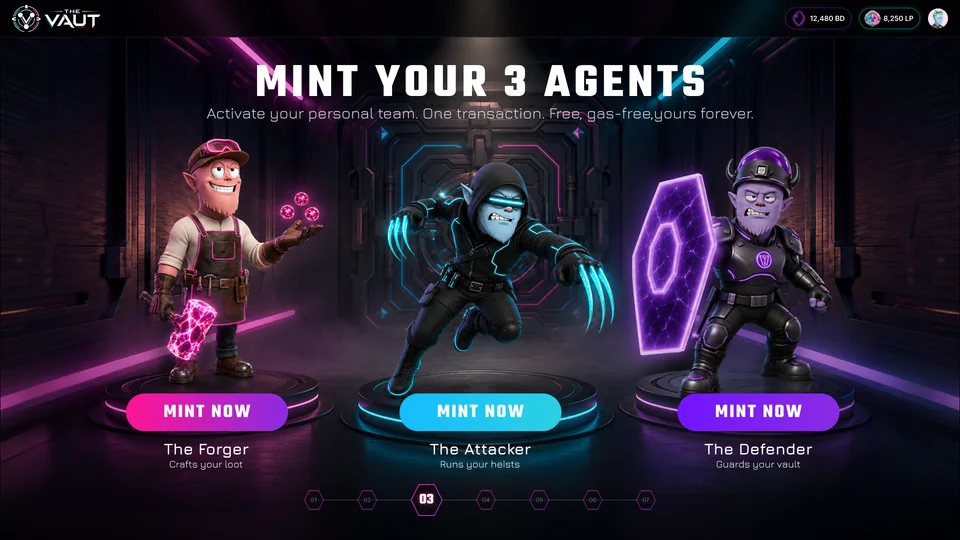
03 · Mint the agents 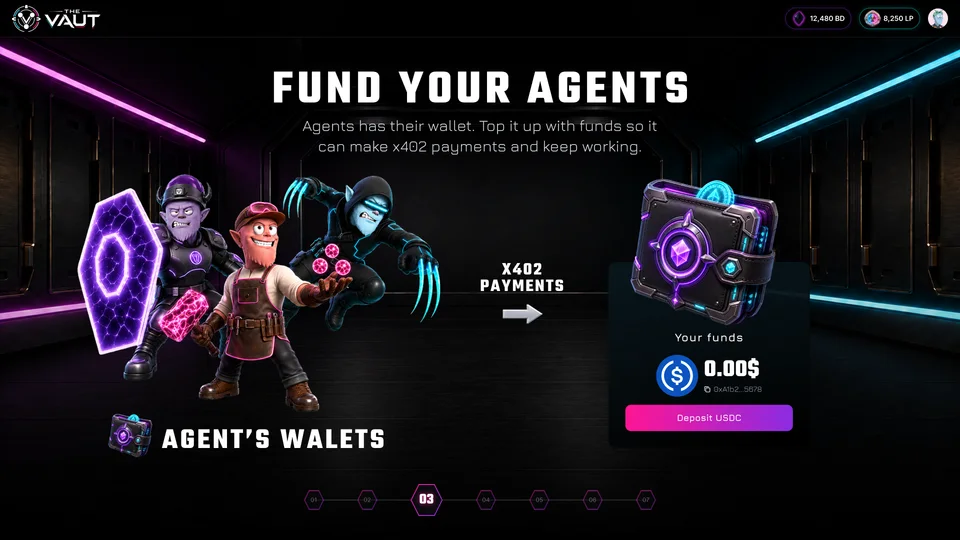
03 · Fund them 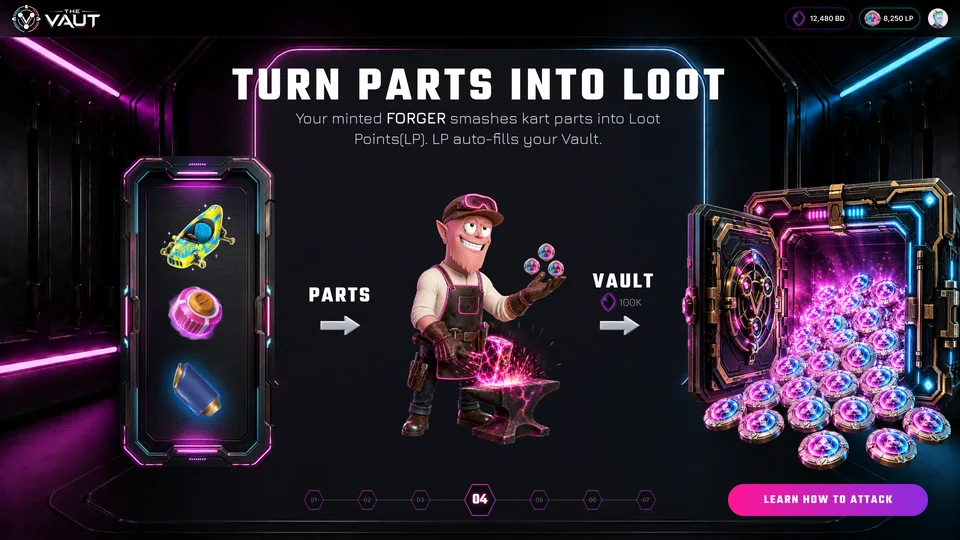
04 · Forge 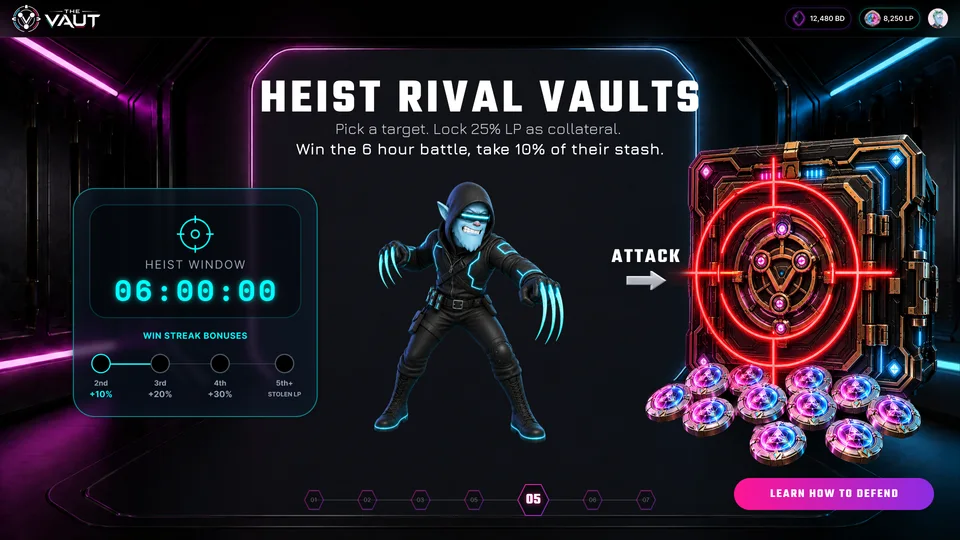
05 · Heist 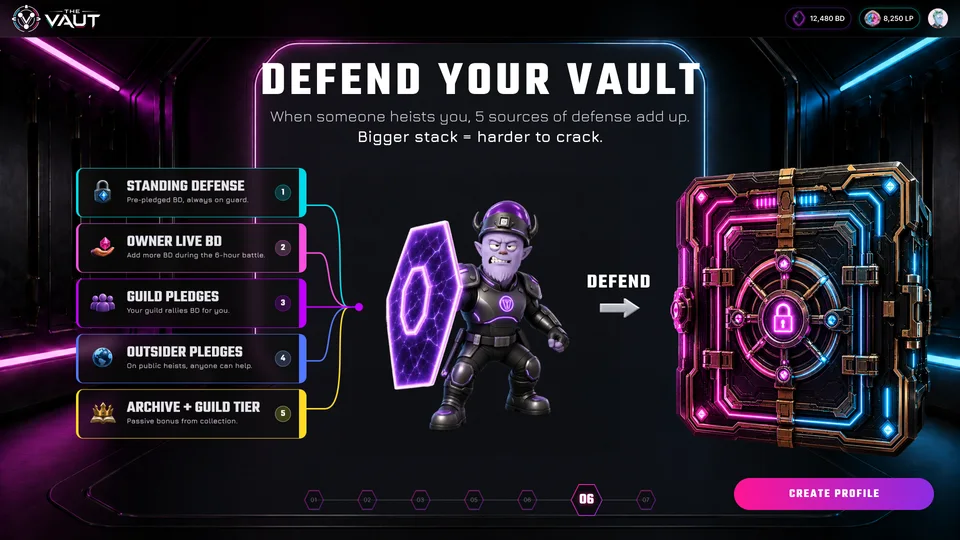
06 · Defend 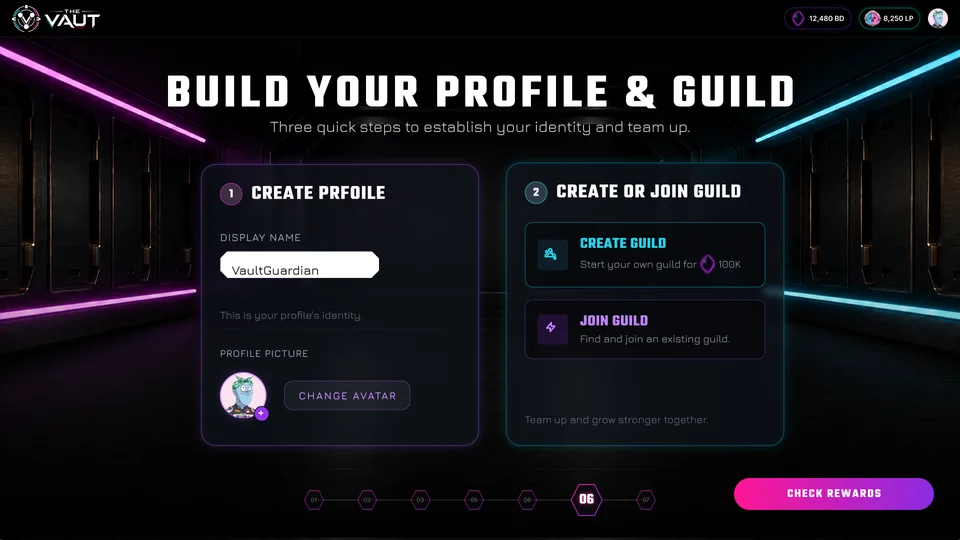
06 · Profile and guild 
07 · Enter Design file · Steps 02 to 07 of the onboarding. Step 01 opens this page.
- 02
The agents play, so their work is on screen
Each player mints three agents in one free transaction and funds their wallets in USDC, so they can pay their own way with x402. From then on the agents play — so the Forger, which turns kart parts into Loot Points, shows its work: what it is forging now against a countdown, the cost, time, yield and multiplier, and where the loot goes.
A badge says the agent is active, with Stop inside it. What stays with the player is the order of rarities to forge, set by dragging four tags.
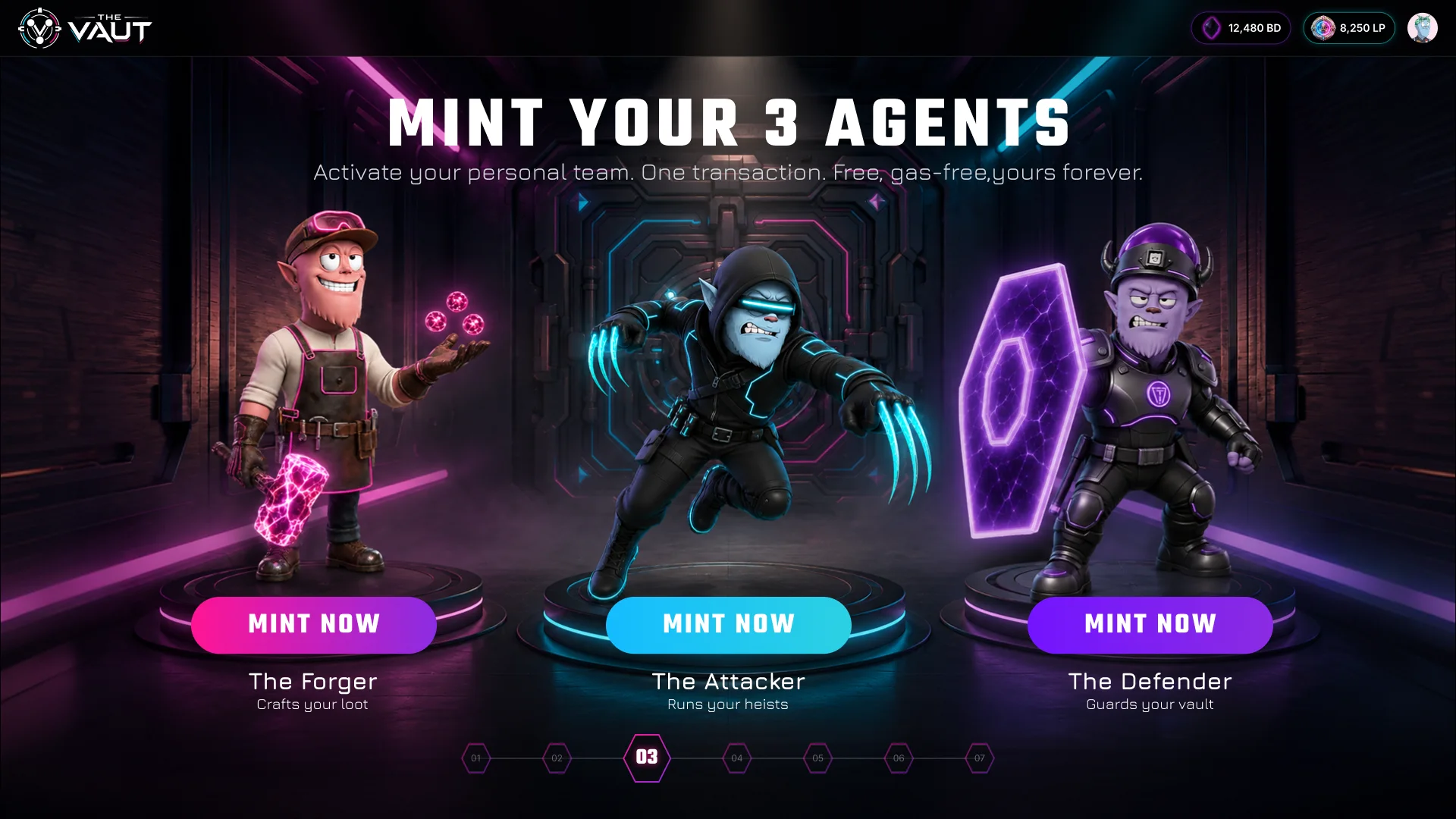
Three agents, one transaction 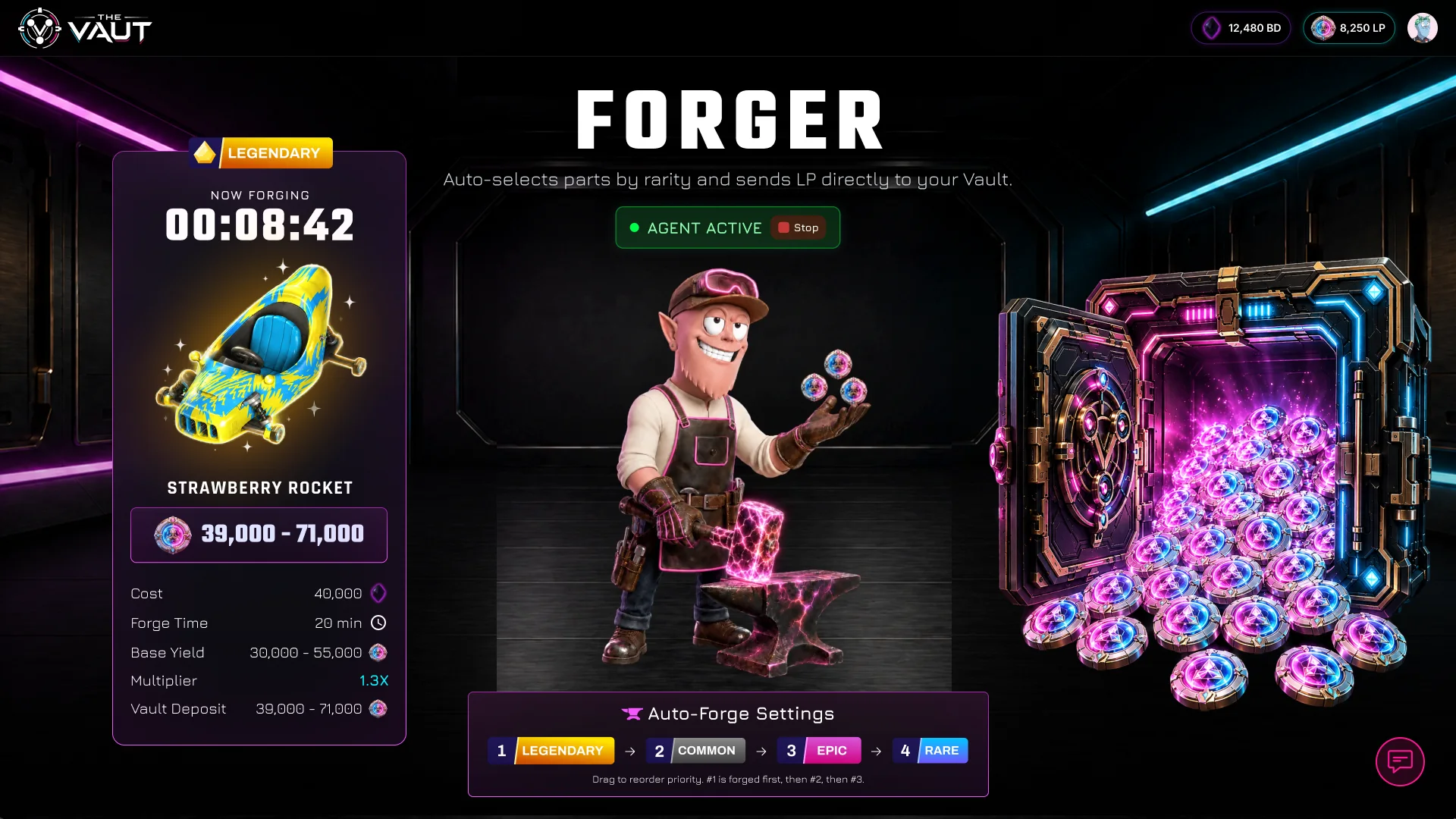
The Forger at work 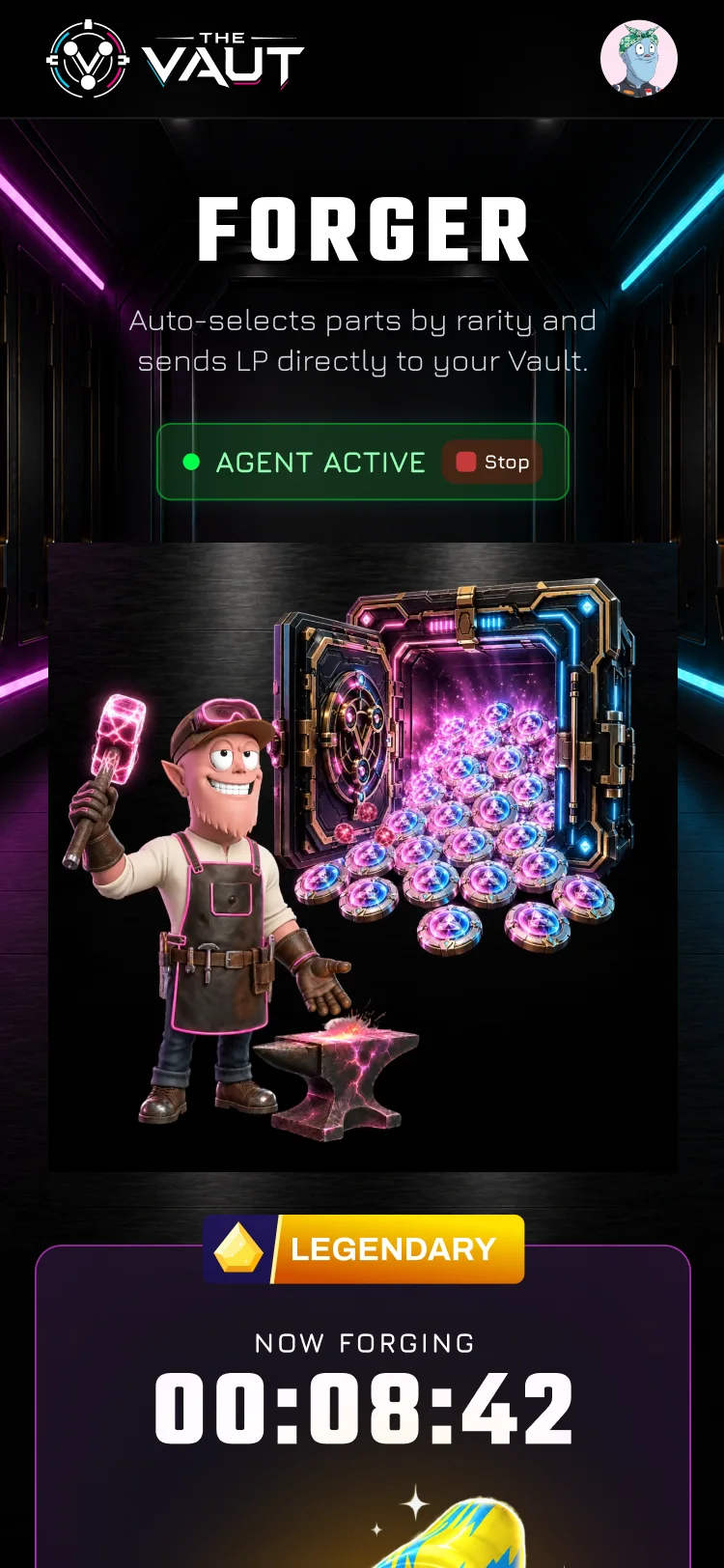
The Forger · 375 Design file · Minting the agents, and the Forger on desktop and at 375.
- 03
Every vault on one map
Targets live in the Galaxy: every vault a bubble in its owner's tier colour — Apex, Heister, Survivor, Rookie — with You in the middle and lines to the vaults in play. Filters for tier, minimum BD, guild and online players sit above the map, and a switch turns it into a list for anyone who would rather read numbers than shapes.
Picking a vault opens its card — Black Diamonds, Loot Points, win rate, heists and defences, the latest activity — and one button: Heist This Vault.
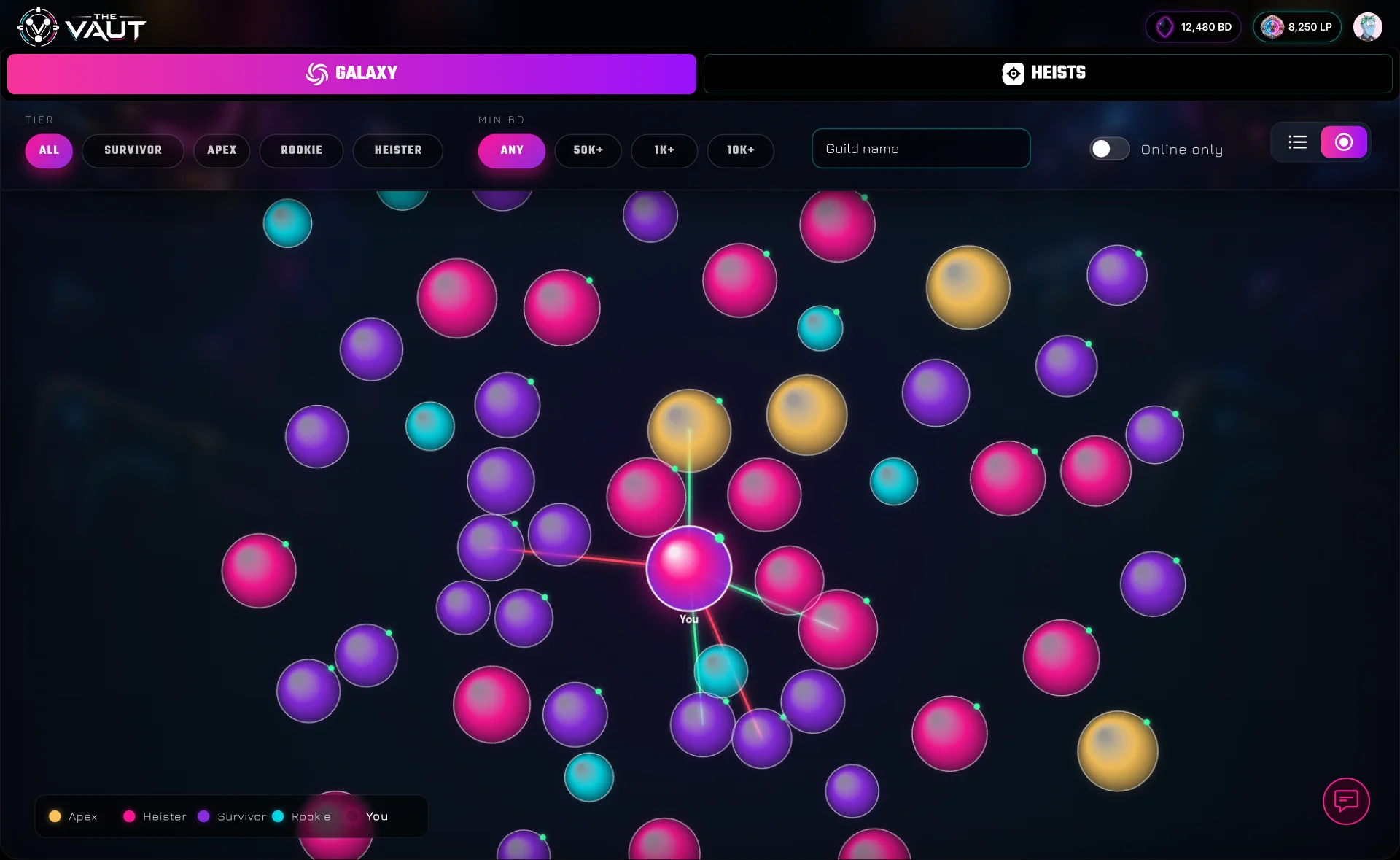
The map 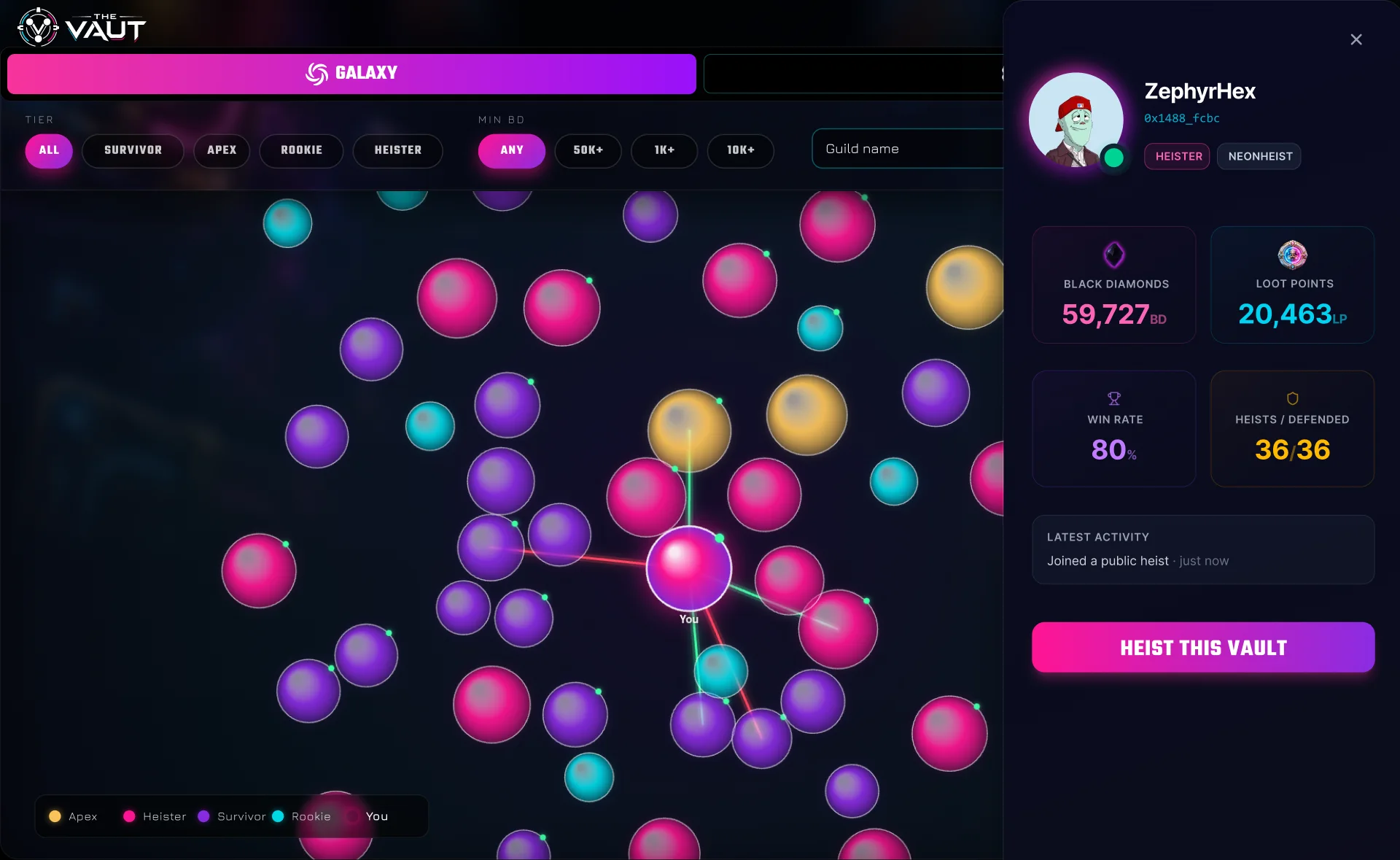
A vault picked 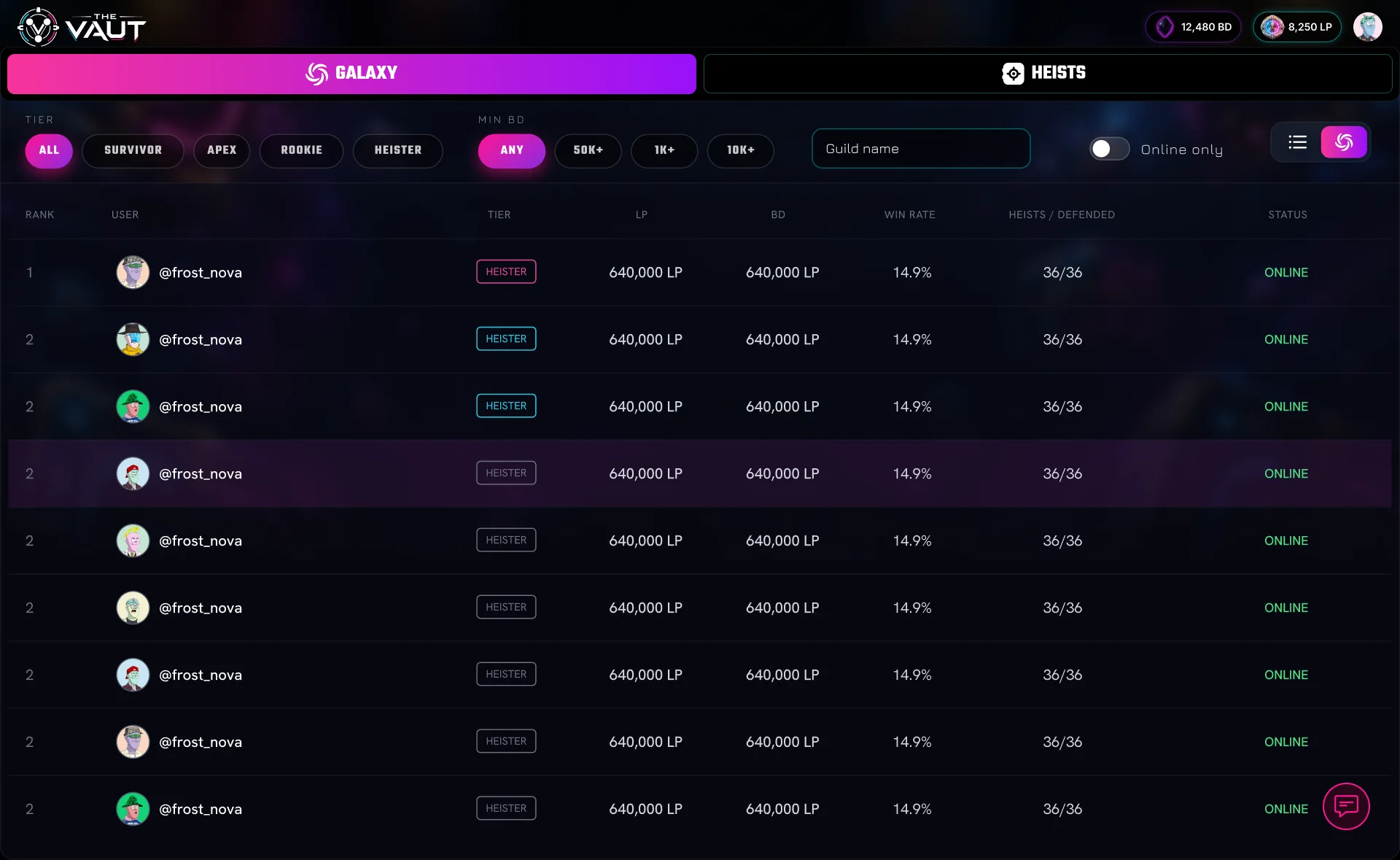
The same vaults, listed 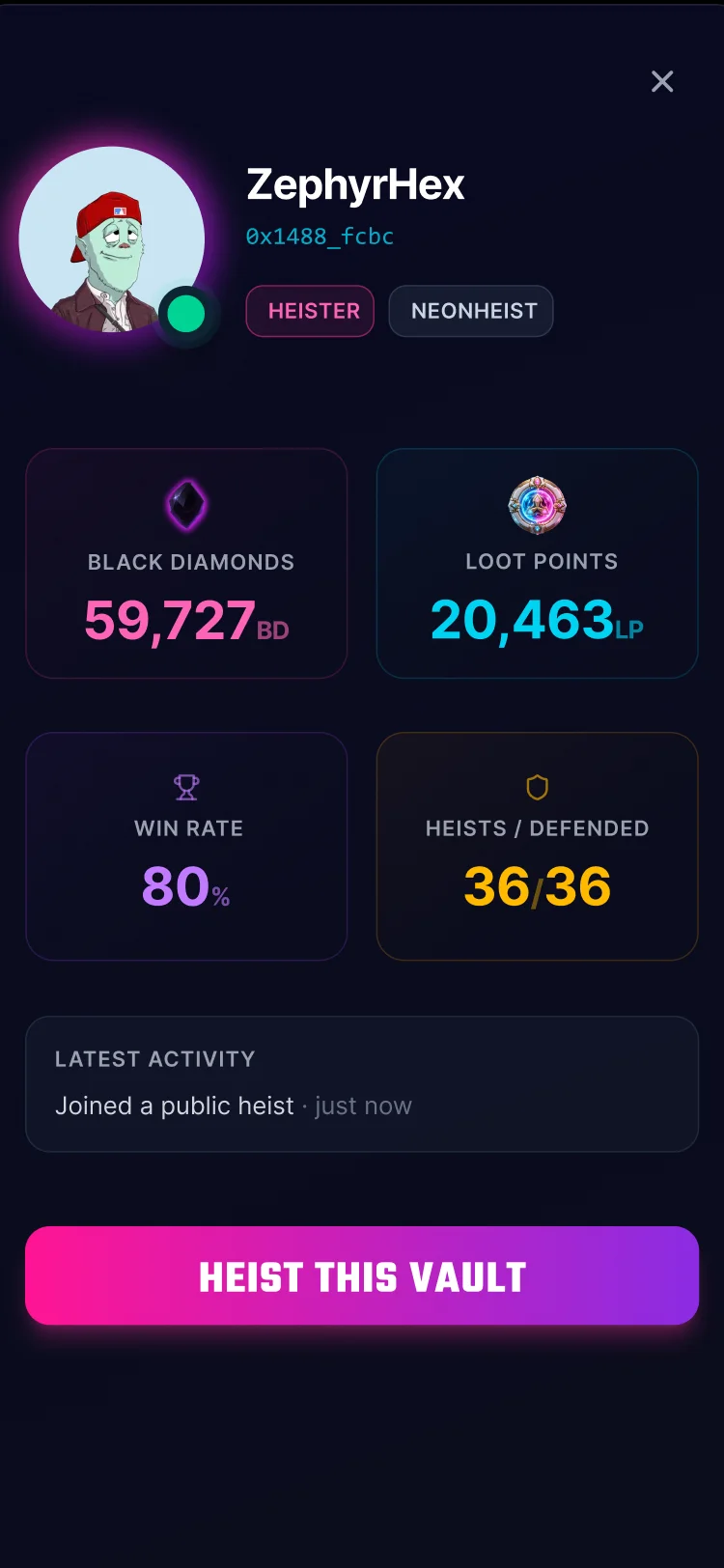
A vault picked · 375 Design file · The map, a picked vault, the list, and the card at 375. The players are sample data.
- 04
A heist, both sides on one screen
A heist puts the attacker and the defender face to face — cyan on the left, magenta on the right — each with their guild, the members backing them and their power, and each with a Deposit Funds box to add to the fight. Between them stand the vault, its value and the lockdown countdown.
Before a target is chosen, that side of the screen is not left empty: it says no opponent is selected, and offers the list of vaults and a search across the network.
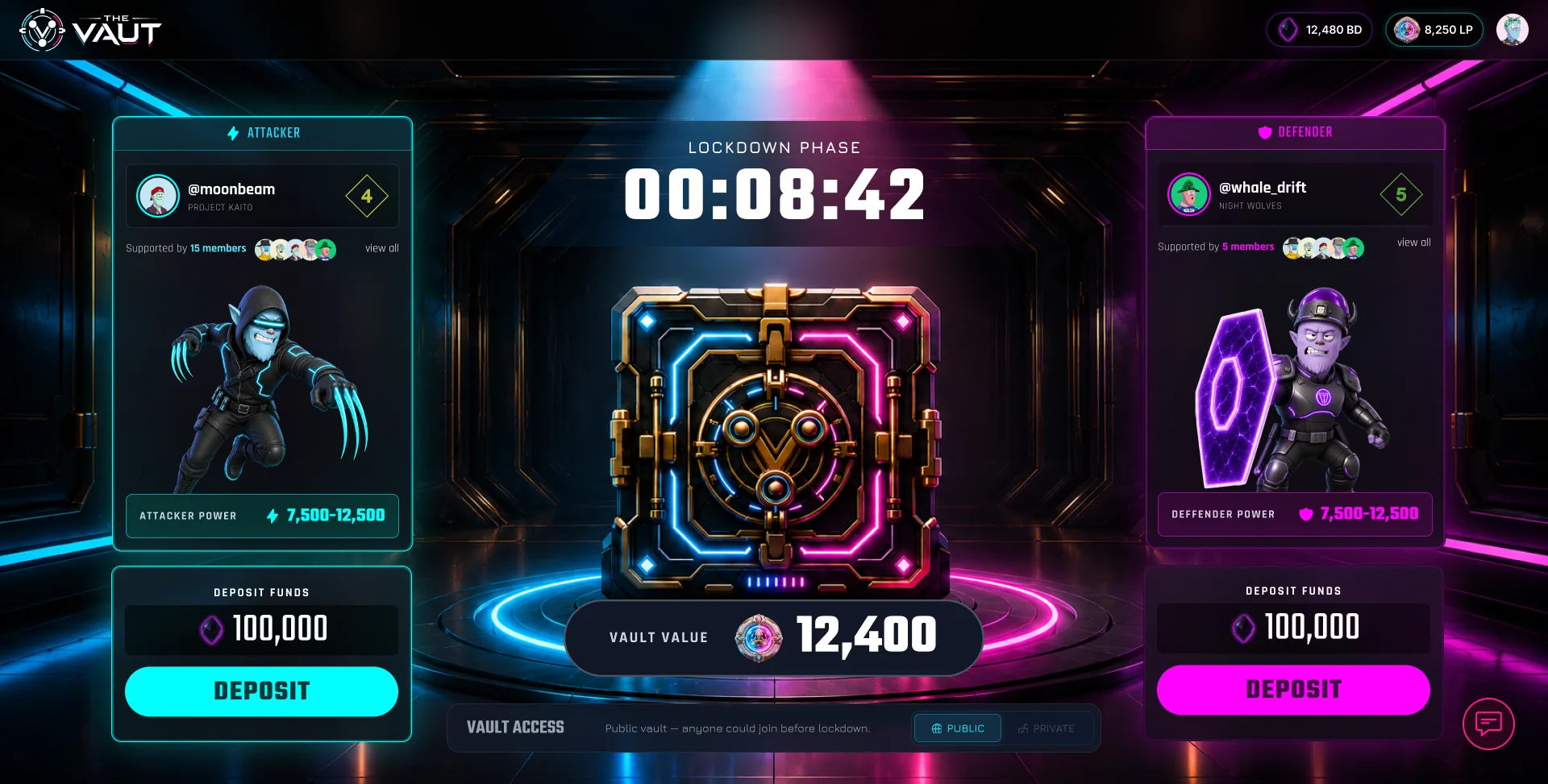
Lockdown 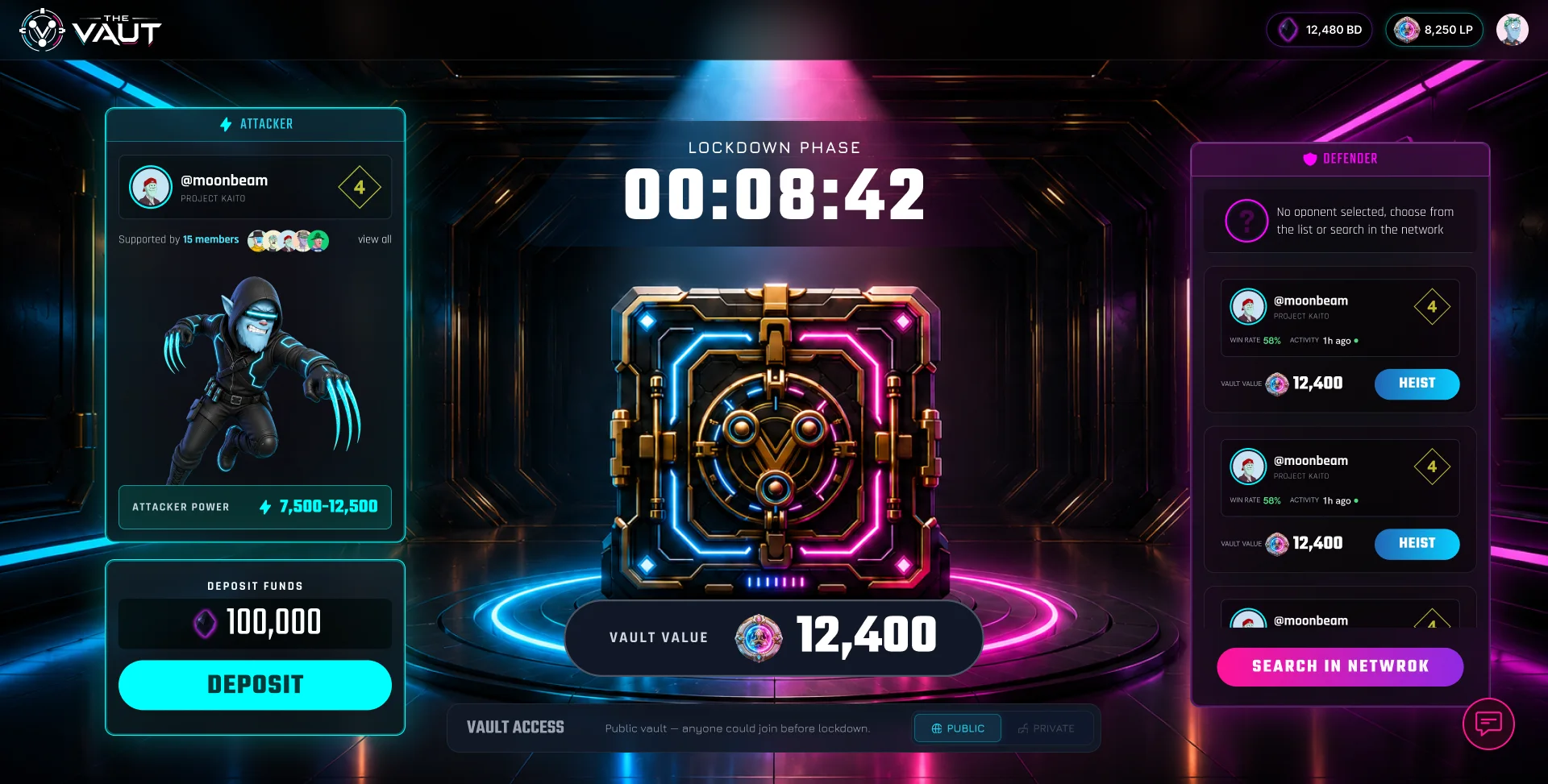
No target yet 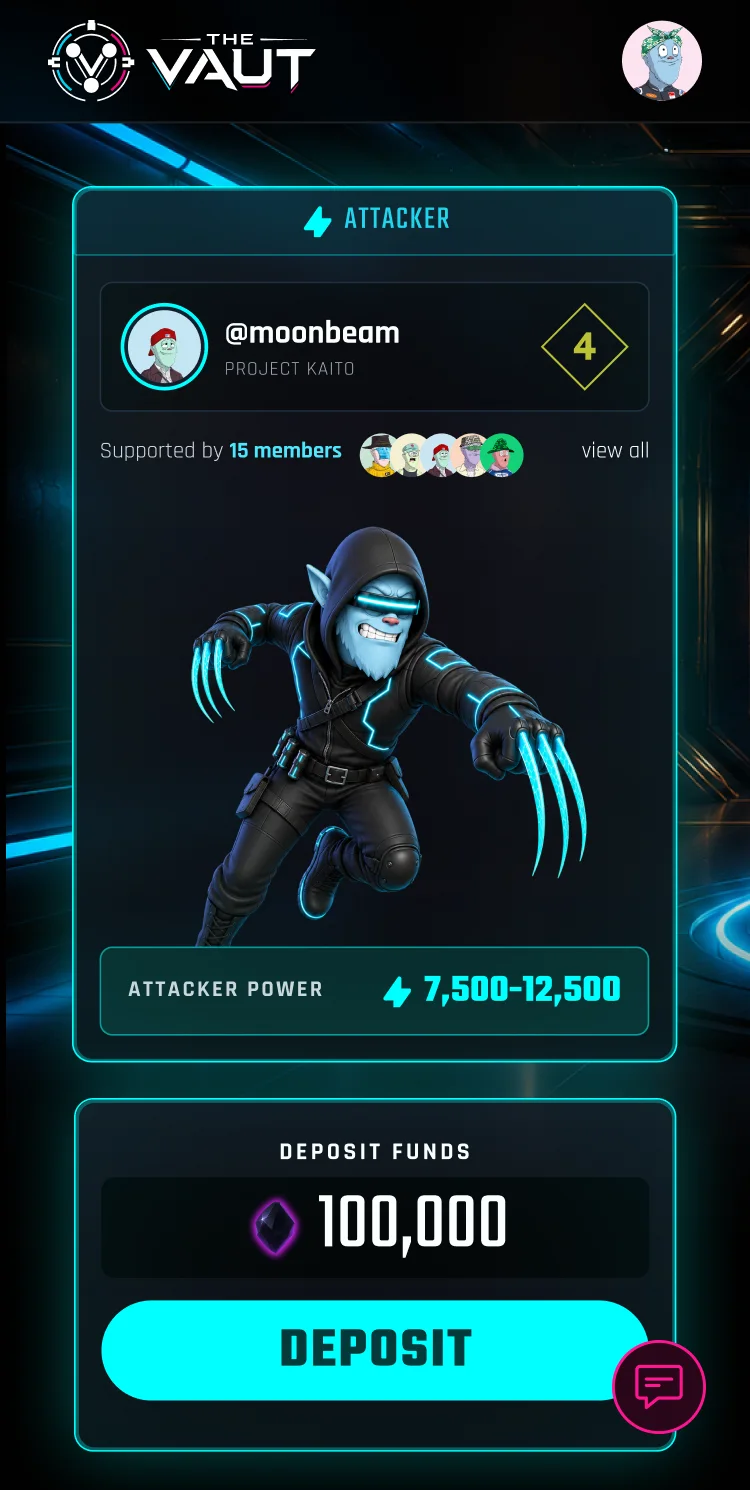
The attacker's side · 375 Design file · A heist in lockdown, the screen before a target is chosen, and the attacker's side at 375.
- 05
Defence, drawn as a sum
Defending is the hardest rule to explain, because five things add up to it: standing defence pledged in advance, the owner's BD added during the battle, guild pledges, outsider pledges on public heists, and a passive bonus from the player's Archives and guild tier.
The step draws it as a sum: five numbered rows, each with its one-line meaning, joined by lines into the Defender and on into the vault. “Bigger stack = harder to crack” is the only sentence it needs.
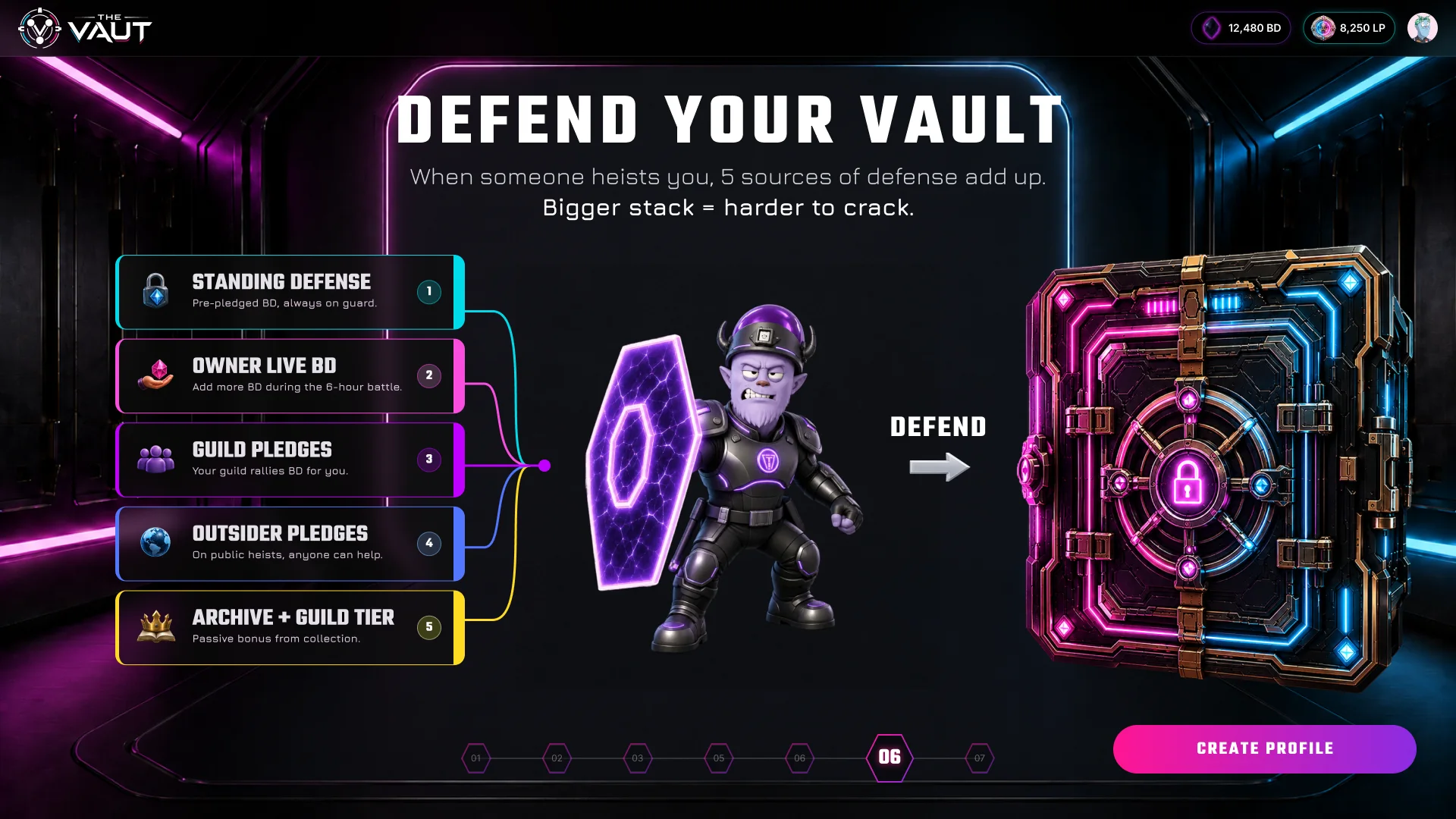
Design file · Step 06 of the onboarding.
- 06
Guilds, chosen by what they are worth
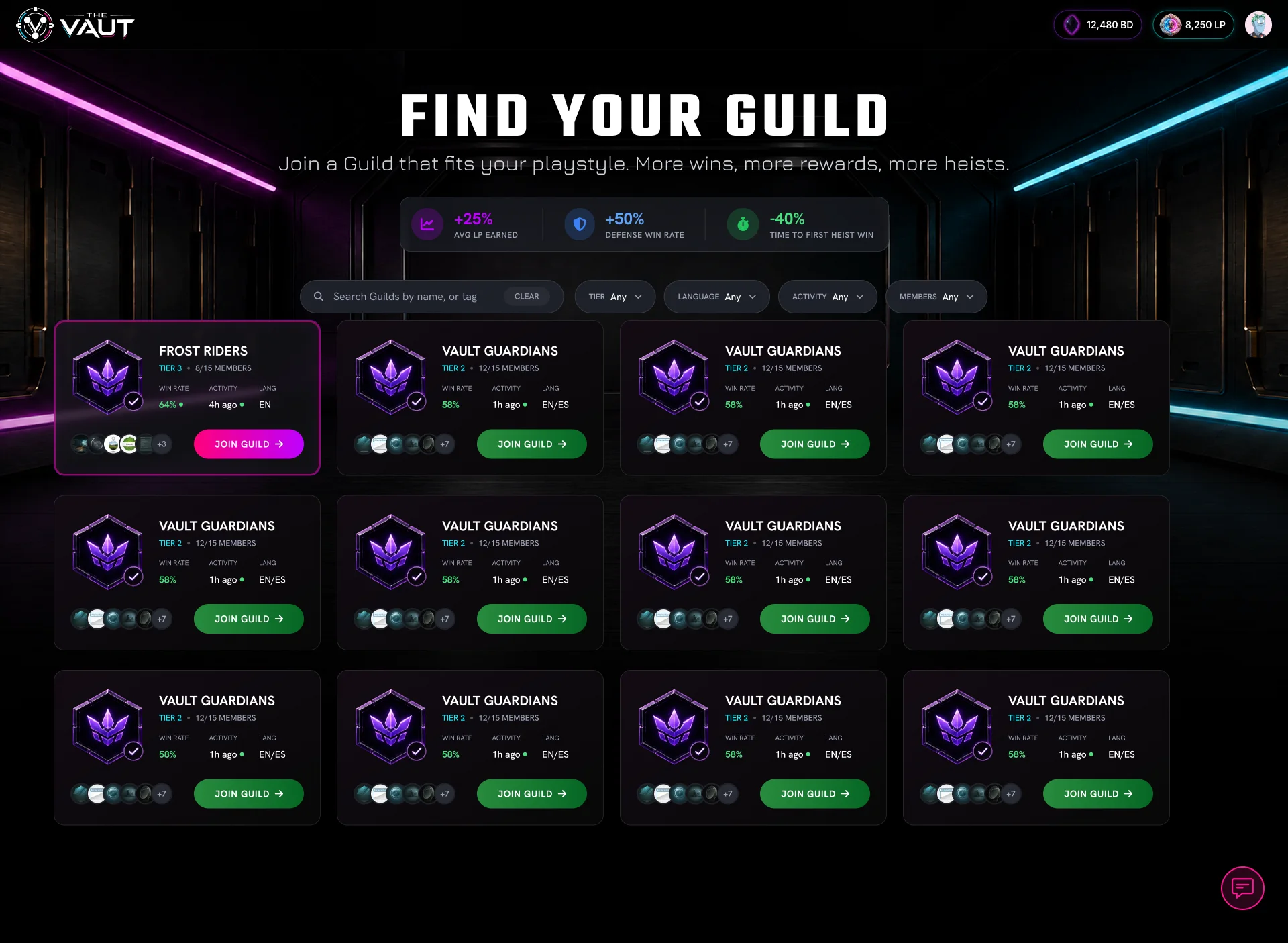
Finding a guild starts with why: three numbers above the search — 25% more LP on average, a 50% better defence win rate, 40% less time to the first heist win. Then a search, four filters, and a card per guild with its tier, members, win rate, activity and language.
A guild's own page puts its standing first — combined LP, tier, season record, defence pool — and its rules beside the tier progress, so a member knows what leaving costs before leaving: a 24-hour cooldown and 48 hours without the guild's buffs. Members, active heists, activity and chat fill the rest.
Find your guild 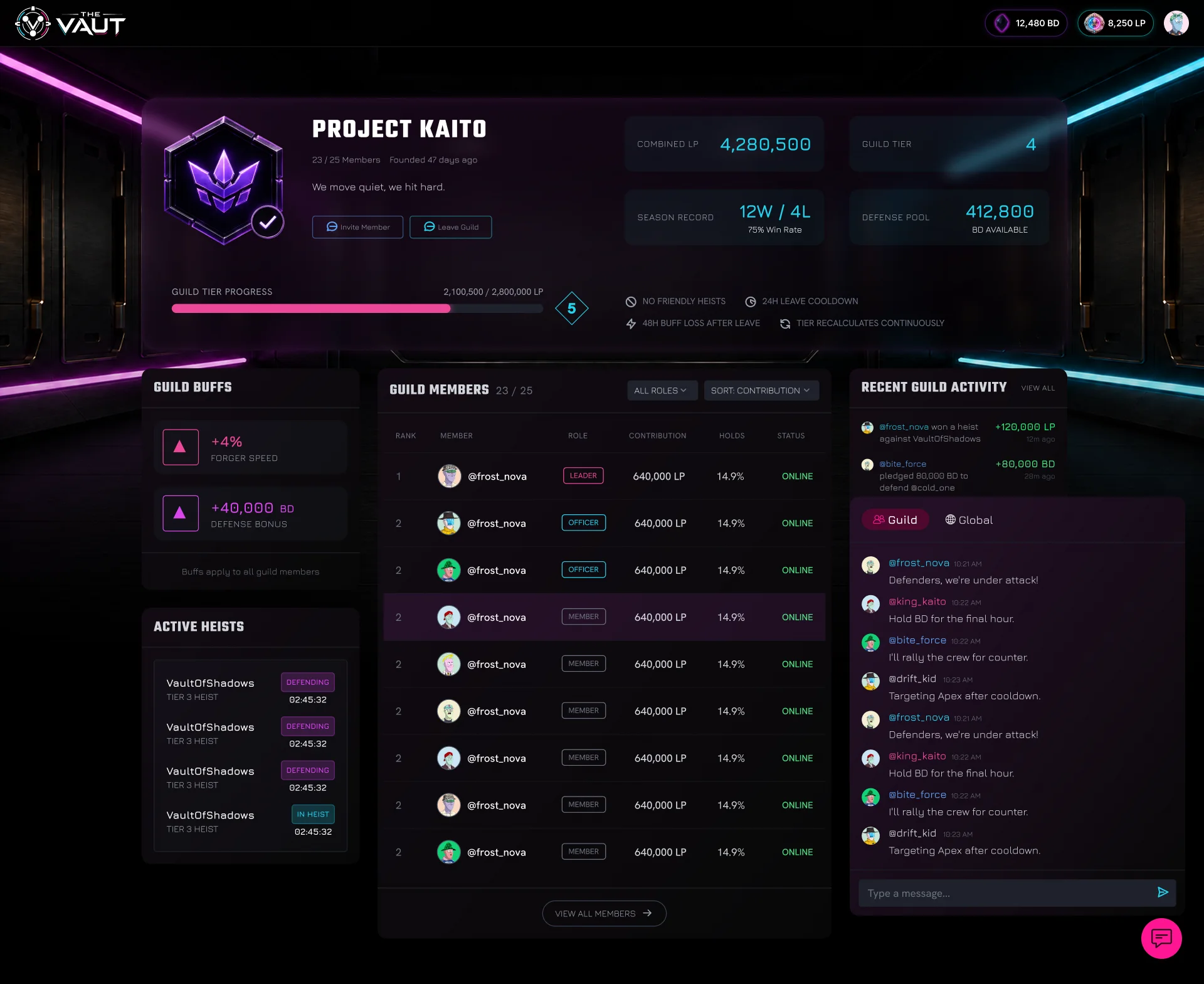
A guild's page 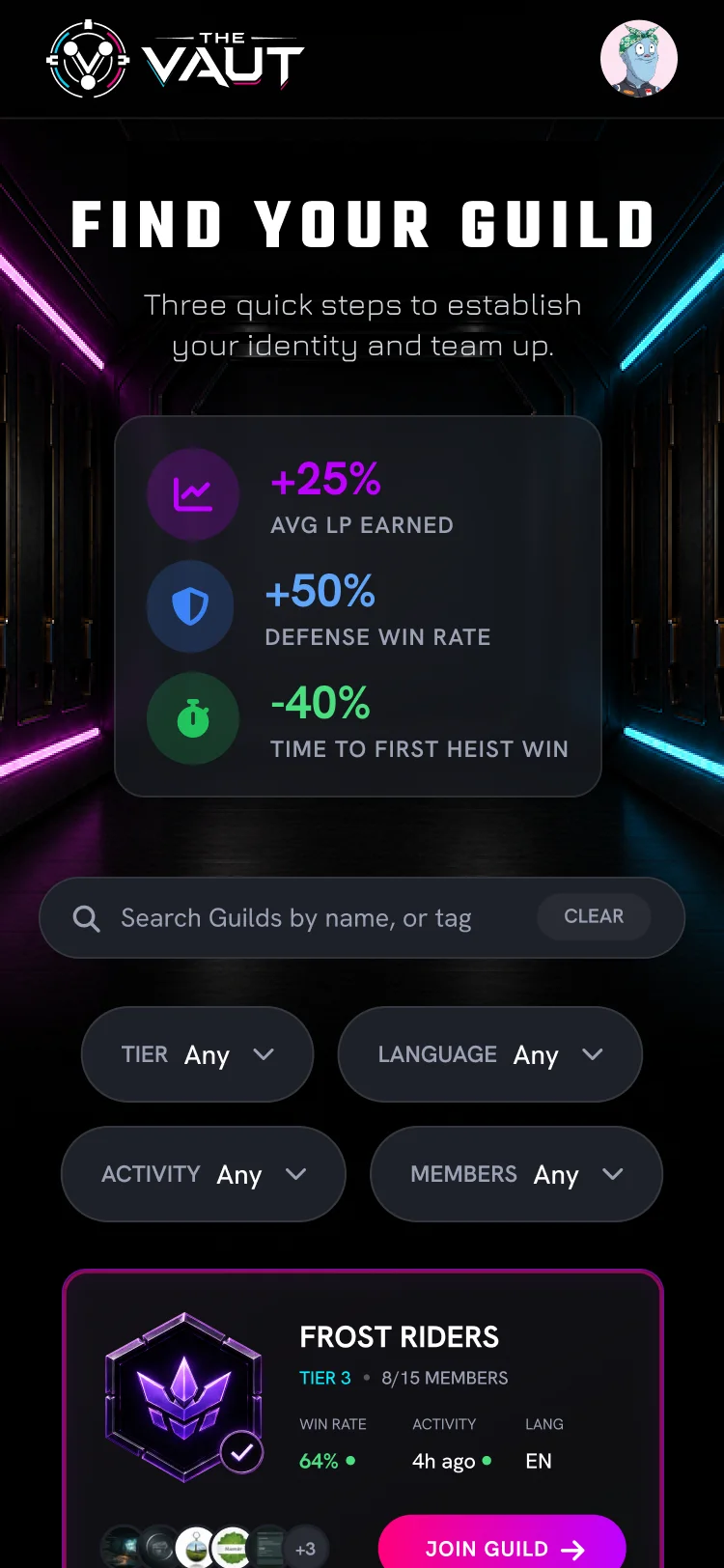
Find your guild · 375 Design file · Find your guild, a guild's page, and the search at 375. The guilds and members are sample data.
- 07
The profile carries the Archives
A player's profile gathers what makes them stronger: active buffs and boosters, the Archive bonuses — each Archive tier with its value, the ones held marked active and the rest one Buy Now away — and the agent wallet with its USDC balance. It is where the Moody Archives chapter meets this one.
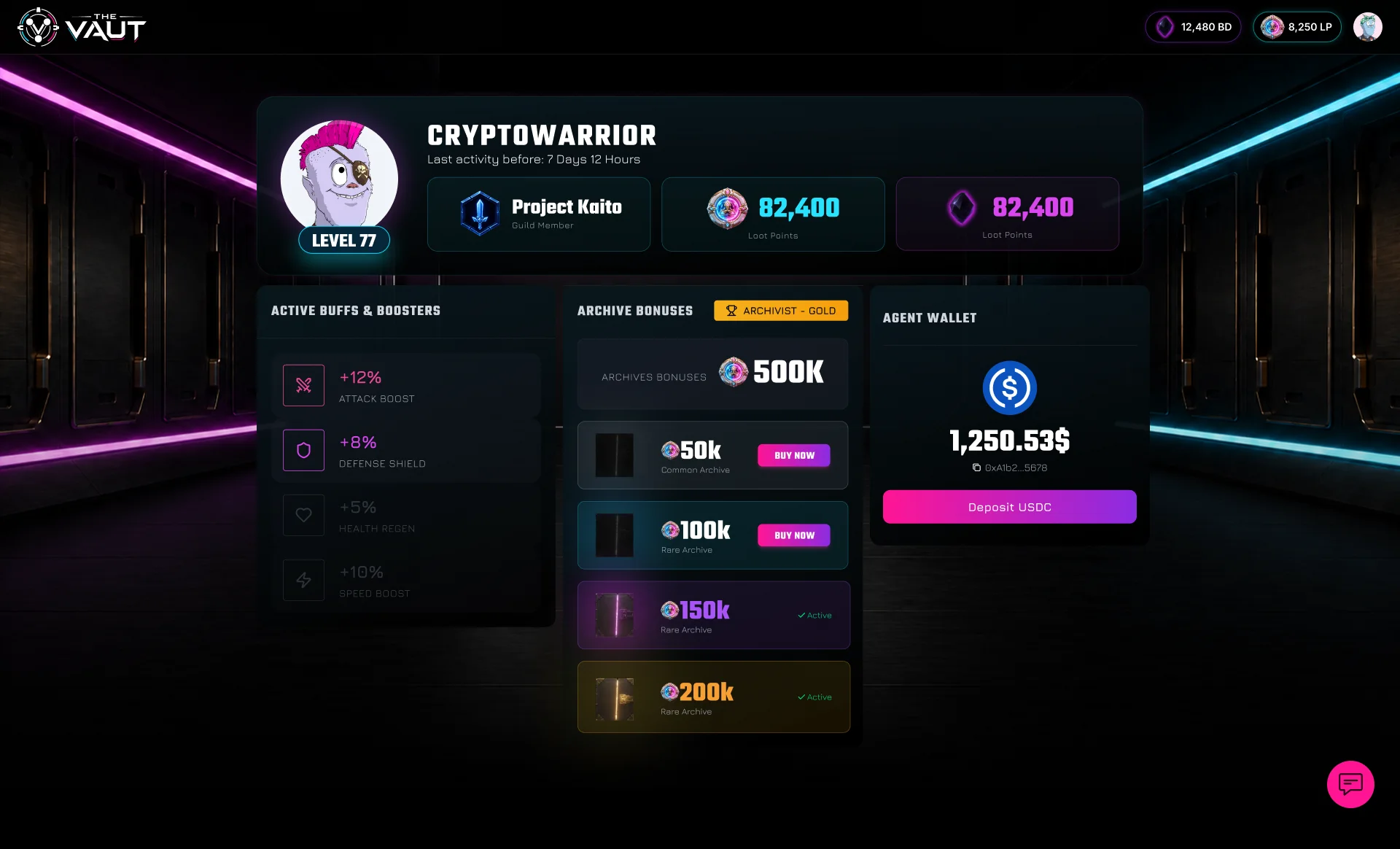
The profile 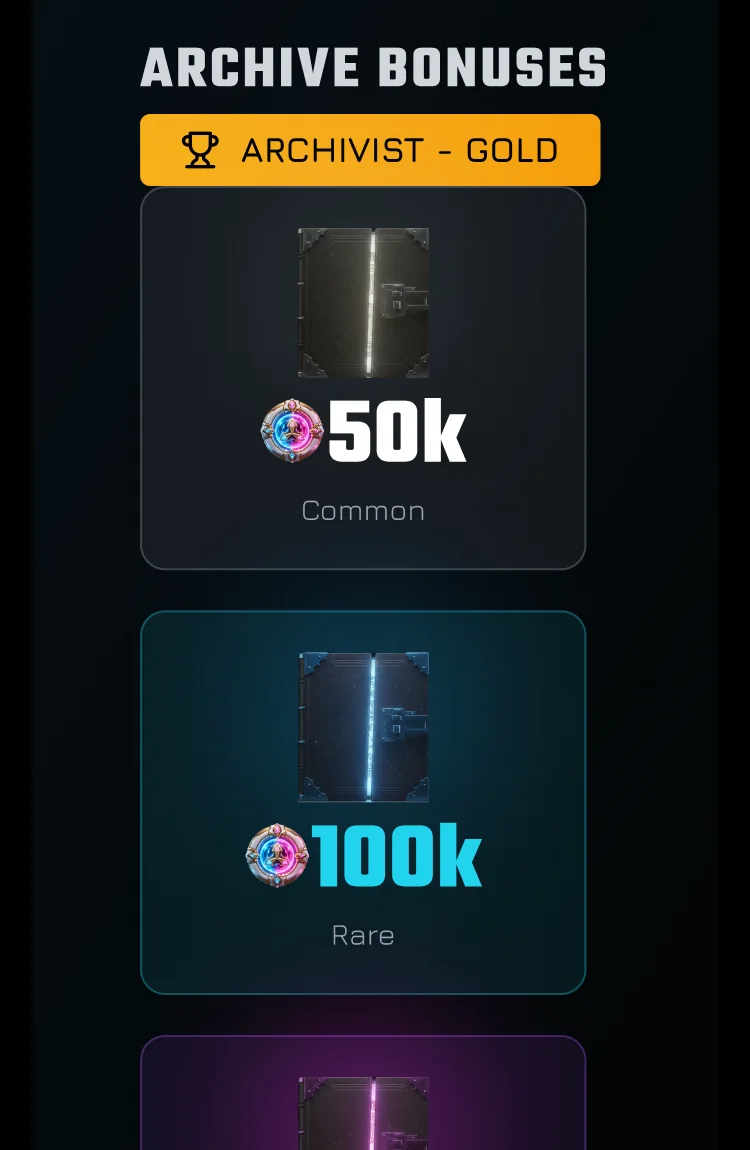
Archive bonuses · 375 Design file · The profile, on desktop and at 375. Both balance cards show the same sample figure in the file.
03 · What I delivered
What I delivered
A seven-step onboarding, the Forger and its auto-forge settings, the galaxy of vaults as a map and a list, the heist from both sides, finding and running a guild, and the player's profile with its buffs, Archive bonuses and agent wallet — on desktop and at 375.
04 · What I would revisit
What I would revisit
The guild page sets its four rules — the ones that cost a player, like 48 hours without buffs after leaving — in its faintest grey, 4.14:1 on the panel, and the members table's headers in the same grey at 4.08:1. Both are 13 to 14px, under 4.5:1; I would lift them to the grey the page already uses for secondary text, #9CA3AF, at 7.89:1.
I would also clean the frames before handing them over: the members table repeats one sample player on every row, the profile's two balance cards show the same figure, the phone's guild search carries the profile step's subtitle, and “Deffender”, “PRFOILE”, “seasson” and “Walets” are in the copy.
Project note
The pictures are the design file's frames. The agents, the host, the vaults, the Pengunatas and the scenes are AI-generated images, as the file's layer names say, and the names, avatars and numbers are sample data. The interface is my design.
05 · Explore the system
Explore the system
A black vault corridor lit in neon: pink to violet for the player's own actions, cyan for the attacker, magenta for the defender, and gold for the Apex tier.
- Display
- Teko
- Labels
- Jura, Rajdhani
- Text
- Hanken Grotesk, Inter
Colour and typography4 colours
- Pink
- #FF1493Where the main buttons' gradient starts. White on it is 3.64:1, enough for their large bold labels.
- Violet
- #8A2BE2Where the gradient ends, and the step markers. 5.96:1 on white, so it carries this page's accents.
- Cyan
- #00FFFFThe attacker's side and its Deposit button. Black on it reads 16.75:1.
- Night#0A0A0FThe ground of every panel. White on it reads 19.75:1.
Hex values and type styles read from the design file's frames; ratios measured against the ground named beside them.
Contact